Churchill Sees Victory in Summer As Possible Fruit of Teheran Plan; CHURCHILL HOPEFUL OF SWIFT VICTORY
By John MacCormacby Wireless To the New York Times
Mex Embassy, London
None0 words
Continue reading...
Share
On this day
Revisit the news, notable people, and historical moments connected to this date.
Portrait 1080 × 1920 PNG · created on your device
Mex Embassy, London
Morgenthau states conf will not bind US; results will be referred to Roosevelt and in turn submitted to Cong for approval
Offers bill to make ex-Presidents Sen members for life
Schrafft's and subsidiaries employes get service war bond awards; honor dinner; bond sales pass $385,000 mark
WITH THE AMERICAN FORCES IN FRANCE, June 19 -- United States troops, advancing with unexpected rapidity, got to a point eight miles from Cherbourg today. Artillery followed in close behind the infantry and this afternoon 155-mm, rifles -- 'Long Toms' -- began to shell that important port.
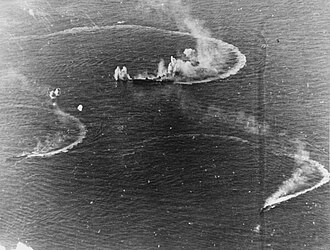
1944World War II: The Battle of the Philippine Sea concludes with a decisive U.S. naval victory. The lopsided naval air battle is also known as the "Great Marianas Turkey Shoot".[†]
The Battle of the Philippine Sea was a major naval battle of World War II on 19–20 June 1944 that eliminated the Imperial Japanese Navy's ability to conduct large-scale carrier actions. It took place during the United States' amphibious reconquest of the Mariana Islands during the Pacific War. The battle was the last of five major "carrier-versus-carrier" engagements between American and Japanese naval forces, and pitted elements of the United States Navy's Fifth Fleet against ships and aircraft of the Imperial Japanese Navy's Mobile Fleet and nearby island garrisons. The battle was the largest carrier-to-carrier engagement in history, involving 24 aircraft carriers, deploying roughly 1,350 carrier-based aircraft.

1944World War II: During the Continuation War, the Soviet Union demands unconditional surrender from Finland during the beginning of partially successful Vyborg–Petrozavodsk Offensive. The Finnish government refuses.[†]
The Continuation War, also known as the Second Soviet–Finnish War, was a conflict fought by Finland and Nazi Germany against the Soviet Union during World War II. It began with a Finnish declaration of war on 25 June 1941 and ended on 19 September 1944 with the Moscow Armistice. The Soviet Union and Finland had previously fought the Winter War from 1939 to 1940, which ended with the Soviet failure to conquer Finland and the Moscow Peace Treaty. Numerous reasons have been proposed for the Finnish decision to invade, with regaining territory lost during the Winter War regarded as the most common. Other justifications for the conflict include Finnish President Risto Ryti's vision of a Greater Finland and Commander-in-Chief Carl Gustaf Emil Mannerheim's desire to annex East Karelia.
1944The experimental MW 18014 V-2 rocket reaches an altitude of 176 km, becoming the first man-made object to reach outer space.[†]
MW 18014 was a German A-4 test rocket launched on 20 June 1944, at the Peenemünde Army Research Center in Peenemünde. It was the first man-made object to reach outer space, attaining an apogee of 176 kilometres (109 mi), well above the Kármán line that was established later as the lowest altitude of space. It was a vertical test launch, and was not intended to reach orbital velocity, so it returned and impacted Earth, making it the first sub-orbital spaceflight.