KOZLOV REACHES A QUIET DETROIT; No Protests Mark Arrival From California -- Mayor Absent From Welcome
By Harry Schwartz
pres Nesmeyanov reptdly gets highest salary in USSR
None0 words
Continue reading...
Share
On this day
Revisit the news, notable people, and historical moments connected to this date.
Portrait 1080 × 1920 PNG · created on your device
pres Nesmeyanov reptdly gets highest salary in USSR
Burma to accept US funds for facilities
USSR repts 2 dogs and rabbit returned safely to earth after being fired into spacs as part of 4,400-lb payload launched by single-stage IRBM on July 2; silent on alt reached; repts flight was 3d for dog Otvazhnaya (Courageous); says research aims were fulfilled; model of dogs' space chamber illus; NASA aide Worf suggests rabbit was used for reproduction study
Cambridge U undergrad pub devotes issue to Britishers impressions; excerpts; USIS buys 1,000 copies for distribution in GB and abroad
Rockefeller issues rapt by Special Task Force on Protection from Radioactive Fall-out urging legis requiring shelters in existing homes and in future homes and bldgs; backs it; rept also urges educ program on fall-out, development of special survival kit to allow persons to stay in shelters at least 2 wks after attack; Task Force head O M Ruebhausen comments; Defense Council meets; backs rept; CIA Dir Dulles s; illus with Rockefeller
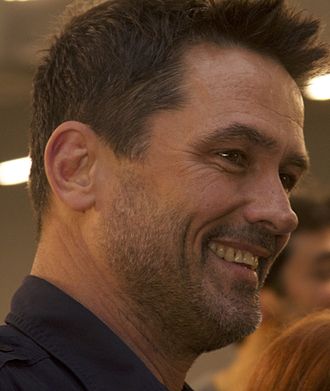
1959Billy Campbell, American actor[†]
William Oliver Campbell is an American film and television actor. He first gained recognition for his recurring role as Luke Fuller in the TV series Dynasty and in The Rocketeer. Then, he became known for playing Rick Sammler on Once and Again, Det. Joey Indelli on Crime Story, Jordan Collier on The 4400, and Dr. Jon Fielding on the Tales of the City miniseries. His most notable films include The Rocketeer, Bram Stoker's Dracula and Enough. He portrayed Darren Richmond on the AMC television series The Killing, Dr. Alan Farragut in the SYFY series Helix and Det. John Cardinal on CTV's Cardinal.

1959Venus occults the star Regulus. This rare event is used to determine the diameter of Venus and the structure of the Venusian atmosphere.[†]
Venus is the second planet from the Sun. It is often called Earth's "twin" or "sister" planet for having almost the same size and mass, and the closest orbit to Earth's. While both are rocky planets, Venus has an atmosphere much thicker and denser than Earth and any other rocky body in the Solar System. Its atmosphere is composed of mostly carbon dioxide, with a global sulfuric acid cloud cover and no liquid water. At the mean surface level the atmosphere reaches a temperature of 737 K and a pressure 92 times greater than Earth's at sea level, turning the lowest layer of the atmosphere into a supercritical fluid. Venus is the third brightest object in Earth's sky, after the Moon and the Sun, and, like Mercury, appears always relatively close to the Sun, either as a "morning star" or an "evening star", resulting from orbiting closer (inferior) to the Sun than Earth.
In 1959, the world population was approximately 2,965,950,351 people[†]