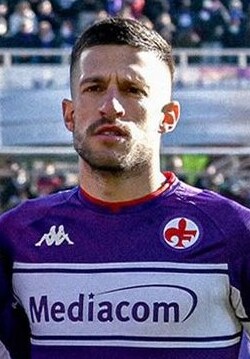
1992Cristiano Biraghi, Italian footballer[†]
Cristiano Biraghi is an Italian professional footballer who plays as a left-back for Serie A club Torino, on loan from Fiorentina, and the Italy national team.
On this day
Revisit the news, notable people, and historical moments connected to this date.
In 1992, the world population was approximately 5,505,989,816 people[†]
1992Cristiano Biraghi, Italian footballer[†]
Cristiano Biraghi is an Italian professional footballer who plays as a left-back for Serie A club Torino, on loan from Fiorentina, and the Italy national team.

1992Kirani James, Grenadian sprinter[†]
Sir Kirani Zeno James GCNG COG is a Grenadian professional sprinter who specializes in the 400 metres. He won the 400 m at the World Championships in 2011 and won the gold medal at the 2012 London Olympics. In the 400 metres, James also won the silver medal at the 2016 Rio Olympics and a bronze medal at the 2020 Tokyo Olympics, thus becoming the first man to earn the full set of three medals in the centennial history of the event. He is Grenada's first Olympic medalist. He holds the Grenadian national record in both the 200 metres and 400 metres.

1992Tomáš Nosek, Czech ice hockey player[†]
Tomáš Nosek is a Czech professional ice hockey forward for the Florida Panthers of the National Hockey League (NHL). Nosek began his professional career in the Czech Extraliga with HC Pardubice before signing with the Detroit Red Wings as an undrafted free agent in 2014. After developing in the American Hockey League (AHL) with the Grand Rapids Griffins, he played a key role in their 2017 Calder Cup championship run.

1992Woo Hye-lim, South Korean singer-songwriter[†]
Woo Hye-rim, known professionally as Hyerim or Lim, is a South Korean singer, rapper, and songwriter known for her work as a former member of South Korean girl group Wonder Girls.
The United States announced yesterday that it had agreed in principle to buy billions of dollars' worth of bomb-grade uranium from scrapped Soviet nuclear arms in an attempt to bolster the shaky Russian economy and to reduce the risks of nuclear accidents or theft. The agreement, which would require the formal approval of both Governments, calls for highly enriched uranium from Russian nuclear arms to be diluted for sale as commercial reactor fuel. It would be the first such agreement, and, if approved, would be a major step to reducing the dangers that made the cold war so unnerving.
The Yugoslav economy, never the world's strongest, has collapsed during the civil war of recent months. But one pugnacious businessman has continued to wheel and deal at a furious pace, culminating with his bold financing of the scheduled comeback of the United States chess genius Bobby Fischer against his old rival Boris Spassky in this Adriatic resort not far from the fighting. In the remnants of Yugoslavia, now a cash-only economy where anything goes, Jezdimir Vasiljevic is known as the "mystery man." He appears to enjoy the title. "I like to be mysterious," he said, pulling hard on a cigarette and mopping the sweat from his brow, "because I like to keep people guessing." Asked about his net worth, all he will say is "millions," adding coyly that his group's sales now amount to about $3 billion a year. 'A Believer in Money' Officially, Mr. Vasiljevic is the owner of a recently established private bank-cum-trading company called Jugoskandic, whose interests include the horse racing track in Belgrade and a large shipping company. Unofficially, he has his hand in just about everything.
It was 92 degrees at noon Saturday, the fifth day after Hurricane Andrew. Ronald Bruscia maneuvered his van around mounds of brush and tangles of fallen power line. Shards of glass flew from his shattered windshield as he drove toward a friend's house that had collapsed during the storm. The friend had offered 50 gallons of gasoline in exchange for help in moving, and Mr. Bruscia was eager for the trade. In the wake of the storm, he and his girlfriend, Pamela Jones, had become eager scavengers and barterers, bound to their neighbors, relatives and even strangers by good will and mutual desperation.
TWO years ago, in the spirit of experimentation, the owner of a home in northeastern New Jersey stopped maintaining his modest lawn on synthetic fertilizers and pesticides and, like growing numbers of suburban householders, went organic instead. At the end of that first year, as described in these pages on Aug. 27, 1991, the lawn appeared lusher and healthier than it had 12 months earlier. It was also different: nature will not be denied once given free rein, and assorted broadleaf plants had jumped in to mix with the grass. Some were weeded out. Others, especially clover, pleased the eye and were allowed to flourish. The resulting appearance, typical of many organic lawns, has since been described generically as "brocade rather than velvet" by Dr. Vivienne N. Armentrout, a lawn consultant in Ann Arbor, Mich.
The people of West Harlem are about to be repaid for putting up with a sewage treatment plant in their neighborhood. Their payback, a most unusual park, will have pools and fields and a view of the Hudson River, all atop a building that processes 170 million gallons of raw sewage a day. Is this really the sort of place one wants to take in the evening air?
Jackie Saltares remembers a time not that long ago when the Puerto Ricans were the undisputed kings of Hispanic New York and Spanish Harlem was the spiritual and physical center of their realm. El Barrio, the neighborhood, was home to thousands of Puerto Ricans who settled into cramped walk-up apartments on the narrow side streets and who bustled along the wide shopping avenues, eager if weary travelers on the road to the American Dream.
WERNER HEISENBERG, the leading physicist in the Nazi attempt to develop atomic weapons, passed information to foreign scientists that alerted the Allies about the progress of the top-secret German effort, a forthcoming book reports. The report, based on declassified intelligence records, gives weight to Heisenberg's statement after the war that he had moral scruples about developing the weapons, but may or may not be decisive in the renewed debate over Heisenberg's motives. Secret recordings of his reaction to the bombing of Hiroshima, made surreptitiously by British intelligence agents, were recently declassified and have been seized upon by Heisenberg's critics as showing he was technically inept.
BY popular reputation, hyenas are repulsive scavengers, their coats a mass of mange, their mouths rabidly agape, their laugh-like calls psychotic in pitch. So it is a splendid surprise to discover, upon visiting a research colony of spotted hyenas sequestered in pens on the hills of Berkeley, that the beast is in fact a beauty, a creature every bit as baronial as that more celebrated carnivore, the lion. Its espresso-brown face is at once tender and strong, familiar and alien, combining a bit of bear, a hint of snow leopard, even a flicker of harbor seal. Its rear legs are considerably shorter than its front, a body plan that allows it to run extremely long distances in pursuit of its prey, and its chest and neck are a mesh of dense muscles, powering a jaw that can easily crush the skull of a large antelope.
"There are eight million stories in the Naked City," a stern-voiced announcer said in narrating that police drama set in New York. The producers of a 24-hour local news cable television channel that begins operations a week from today are painstakingly planning to insure that potential viewers and advertisers will not tune in to eight million stories about crime. New York 1 News, as Time Warner Cable calls its service, will compete against local newscasts on broadcast television stations that are infused with enough sensationalism to fill a newsstand's worth of tabloids. Cable television often presents counterprogramming for somewhat younger, more affluent audiences, and New York 1 News will present alternative fare for those seeking information beyond what local newscasters delight in describing as "senseless slayings" -- no doubt to distinguish them from the sensible ones. Not the Murder Network "It is not the New York City Murder Channel," Paul Sagan, vice president of news and programming at New York 1 News, asserted during an interview last week at the channel's office at 460 West 42d Street, near 10th Avenue. The office was bustling with start-up activities, from news anchors rehearsing to sets being built.
Nazi Traitor or Failure? Did Werner Heisenberg deliberately fail to build a Nazi A-bomb? Newly released documents have rekindled the debate. Science Times, page C1. Stopping Speeding Buses Undercover New York troopers have been riding buses to catch speeding drivers. More than 100 of them will be summoned to court. Page B1. Athletics Trade Canseco Oakland traded slugger Jose Canseco to Texas for Ruben Sierra and two other players. Page B9.
R. H. Macy & Company announced yesterday some of its plans to shore up its operations, indicating that the bankrupt retailer will require more time to fix its business than analysts had expected. The preliminary plan, which was presented to creditors last week, is the first public acknowledgment by Macy that its problems go far beyond excessive debt. Four of the six strategies it sketched out yesterday went to the heart of the way the company merchandises and markets itself. Only one -- reducing expenses -- directly addressed the balance sheet.
Companies R.H. Macy announced plans to shore up its operations. The preliminary plan that was sketched out was Macy's first public acknowledgement that its problems go far beyond excessive debt. Four of the six strategies, which were presented to creditors last week, go to the heart of the way the bankrupt retailer merchandises and markets itself, indicating that the problems will take more time to fix than analysts had expected. [ Page D1. ] A "merger announcement" from Mario Gabelli, a money manager, on the TV show "Wall Street Week," sent shares of BHC Communications and United Television up in early trading, but their gains were trimmed later in the day. [ D1. ] Boeing promoted Philip M. Condit to president, and he was widely viewed as heir apparent to Frank Shrontz, the aircraft maker's 60-year-old chairman. [ D1. ] Bank of Boston agreed to acquire Society for Savings, Hartford, in a stock deal worth about $200 million, furthering the carving up of the Connecticut banking market by larger banks. [ D3. ] Biogen shares fell 75 cents on Nasdaq to $22.75 after Vicki L. Sato, a 44-year-old former Harvard biology professor said she would leave the company, where she was the top research manager, for a similar job at Vertex Pharmaceuticals, a Cambridge start-up company. Its shares rose 50 cents, to $9.50. [ D3. ] Medco Containment Services announced a $436 million agreement to acquire Diagnostek Inc., a drug distributor that recently disappointed investors, through an exchange of stock. [ D3. ] Meyer Blinder was sentenced to 46 months in prison on Federal charges of racketeering and securities fraud. The 70-year-old founder of a Colorado penny-stock brokerage firm was convicted of bilking thousands of investors of millions of dollars. [ D3. ] International Cortland, N.Y., where Smith Corona is laying off 875 of its 1,300 workers before moving its typewriter manufacturing operations to Mexico, is feeling the pinch that other communities may suffer under a North American Free Trade Agreement. [ A1. ] The U.S. said it had agreed in principle to buy billions of dollars' worth of bomb-grade uranium from retired Soviet nuclear arms in a bid to bolster the shaky economy of the former Soviet Union and to reduce the risk of nuclear accidents and theft. [ A1. ] The Economy Sales of new homes slipped 2.6 percent in July to a seasonally adjusted annual rate of 563,000 units, the Commerce Department said, despite cheaper mortgage rates and a median price of $115,000, which was down sharply from June. [ D5. ] Markets The Dow industrials fell 10.26 points to close at 3,257.35 in a late selloff, ending a streak of four winning sessions. [ D6. ] The Treasury bond market was little changed ahead of the Labor Day weekend, as investors focused attention on European markets and the outlook for the dollar. [ D13. ] The dollar declined in uneventful trading, while the mark and the Swiss franc benefited from a move to quality. [ D14. ] Energy futures prices extended their recent strong gains. [ D14. ] Today's Columns The effectiveness of managed care is being questioned as a means of slowing the rise of health- care costs. The Congressional Budget Office says it appears not "to have affected systemwide costs." Milt Freudenheim: Business and Health. [ D2. ] Shares of restaurant companies have held their own after a banner 1991. Despite the recession, Americans are spending 43 cents of every food dollar eating out. Market Place. [ D6. ] Time Warner Cable's New York 1 News plans competition for broadcast TV's local newscasts, eschewing their sensationalism and accent on crime news. Stuart Elliott: Advertising. [ D11. ]